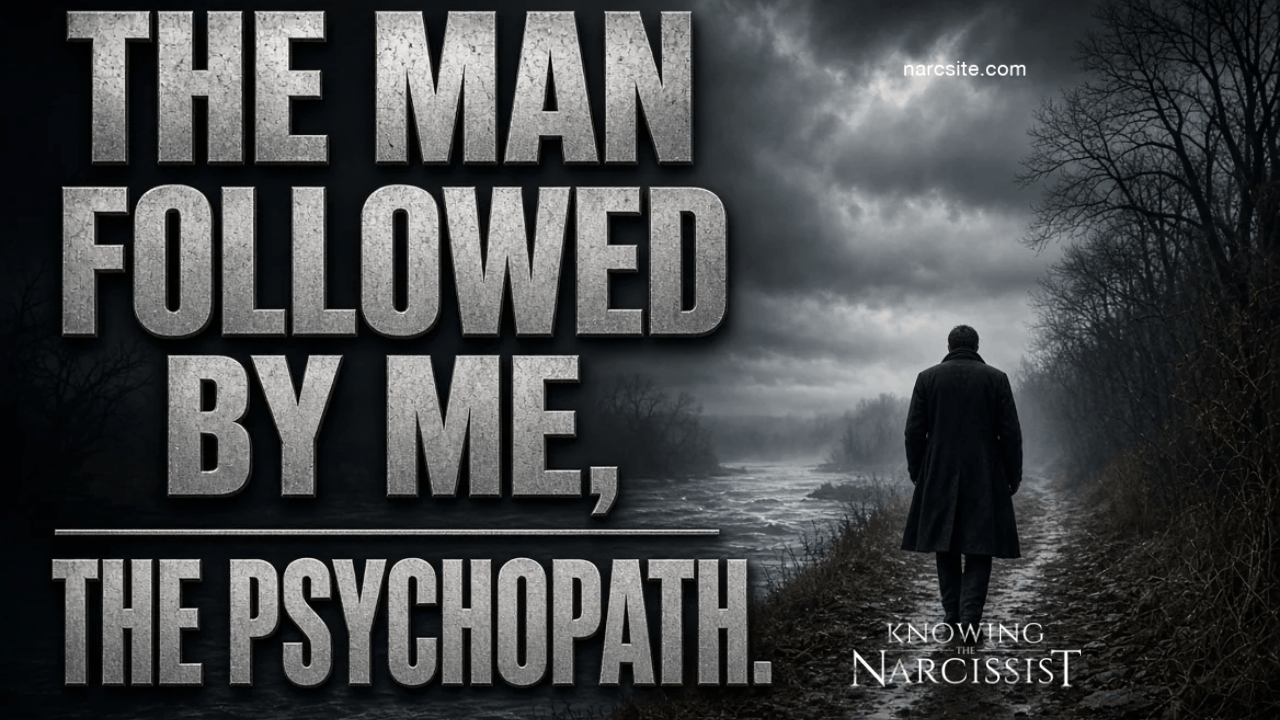
The Man Followed By Me, The Psychopath
I let him have forty paces. That was the number I settled on without
arithmetic. Any fewer and the departure would have been a retreat, and
any more would have turned it into a disappearance. Forty paces let
him believe he had chosen.
I stood, folded the empty cup into the bin by the bench, and followed.
The path ran beside the river, then away from it, then back, the way
paths do when they were laid by people who wanted the water in view
but not underfoot. Willows leaned over the bank. The light had begun
to flatten, that late-afternoon hour when shadows stop describing
objects and start describing intentions. Ahead of me he walked with
the stride of a man pretending he is not hurrying. His shoulders were
high. His right hand kept going to his pocket, touching the phone, and
leaving again without drawing it.
At the first bend he looked back.
I did not duck, or slow, or lift a hand. Concealment is a confession,
and I have no use for confessions I haven’t scheduled. I only
continued at the same pace, and I watched the information travel
across his face: still there. He faced forward again. His stride
lengthened by perhaps four inches.
That was the first count. I kept it.
At the second bend he looked back again, faster. At the third he did
not look at all, which told me he had stopped trusting his eyes and
started trusting his ears. A frightened man listens for footsteps the
way a drowning man listens for a voice. I walked on the soft edge of
the gravel, where the sound thinned, and let him hear nothing at all.
Silence, I have found, frightens more reliably than noise.
The path narrowed where a retaining wall rose on one side and the bank
dropped on the other. Below, the river had picked up speed and
darkened where it pooled against the stone. He slowed there. Not by
choice. The narrowing forced it, and when he slowed I closed the gap,
and when the gap closed to six or seven feet he turned around and
stood very straight, with the posture of a man who has decided to be
brave and is waiting for his body to agree.
“Are you following me?”
“I’m walking,” I said. “The path is public.”
“That’s not an answer.”
“It’s the accurate one. You’d prefer a different one, which is not the
same as wanting a true one.”
His hand went to his pocket again. This time he took the phone out,
held it against his thigh, screen dark. I noted that he had not
unlocked it. He wanted me to see it more than he wanted to use it.
“I’ll call someone,” he said.
“You might. Who?” I kept my hands loose and visible, a courtesy that
costs nothing and purchases a great deal. “Consider the call. A man on
a riverside path, in daylight, is being followed by another man who
has said nothing threatening and done nothing but walk in the same
direction. What would you report? That I knew about the cup?”
His throat moved. He did not answer.
“That is the part that unsettles you,” I said. “Not me. The fact that
nothing I’ve done has a name. When a thing has no name, the mind
supplies the worst one available.”
A cyclist passed us, bell chiming, a flash of yellow and gone. The
man’s eyes followed him a half-second too long. He had considered
shouting and had weighed it, and I saw the weighing, and I saw the
weighing lose.
“What do you want?” he said. His voice cracked on the last word, and
he heard it crack, and the hearing made it worse.
“Look at the water.”
“No.”
“I’m not asking you to jump in it.” I let a little amusement into my
voice, because the absence of it would have frightened him more
precisely than its presence. “That is what you’ve been rehearsing for
the last four hundred yards, isn’t it? The river. The wall. The narrow
place. You’ve built the whole scene. You’ve given me a motive, a
method and a clean exit, and you’ve cast yourself as the man who
should have taken the other path.”
He stared at me. His lips parted and closed.
“It’s a very efficient imagination,” I said. “It saves me a great deal
of effort. Most people do the hardest part of the work themselves.”
“Stay away from me.”
“I will. Soon.” I tilted my head toward the river. “But first, answer
something. When you stood up from the bench, you said I was describing
myself. Not people in general. Why did you say that?”
“I don’t know.”
“You do. You noticed something and you said it before you could stop
yourself. That is rarer than you think. Most people never say the
thing they actually noticed. They say the polite thing, the safe
thing, the thing that lets them leave.”
The wind moved in the willows. Somewhere downstream a bird lifted
from the shallows with a sound like a wet sheet being shaken.
“You talked about accounts,” he said slowly. The fear had not gone,
but something else had slid underneath it, the beginnings of
attention. “Balances. Closing. You said people hand you maps.”
“I did.”
“What happens to the map?”
I did not answer at once. I let the silence stand there and do its
work, and I watched him bear it for four seconds, five, six.
“That is the correct question,” I said. “It is also the one that
should worry you, because it is the only one you’ve asked that wasn’t
about yourself.”
He took half a step back, and his heel found the edge of the gravel. I
saw him feel it. I saw him understand where the bank was.
“Careful,” I said gently. “The ground is softer there.”
He moved forward again, toward me, away from the drop, and that was
the worst thing he could have done, because it closed the distance. We
stood barely an arm’s length apart. I could smell the coffee on him
and under it something sourer, the chemistry of adrenaline.
“I have a wife,” he said. It came out too fast. “People know where I
am. I told someone I was coming here.”
“Did you?”
His eyes flickered. It was a very small flicker. A man telling the
truth does not need to check.
“No,” I said, almost kindly. “You didn’t. And you walked this path
alone, on a weekday, at the hour the joggers thin out, because you
wanted to be unobserved. That was the decision I noticed on the bench.
You weren’t nervous about the conversation. You were nervous that you
had finally been seen doing something you had planned not to be seen
doing.”
The colour left his face , the way light leaves a room.
“What did you do?” I asked. “Before you sat down. What was in the bag
you left in the car?”
“How do you—”
“I don’t. That’s the point. I guessed, and your face confirmed it, and
now we both know something neither of us said.”
He swayed. His hand came up, not in defence, just a reflex, a man
reaching for a wall that wasn’t there.
“Please,” he said. “Whatever this is. I’ll give you whatever you want.”
I looked at him for a long moment, and I let him see me look. Then I
glanced past his shoulder at the river, dark and quick against the
stone, and back at him.
“There is a man,” I said, “who is going to arrive on this path in
about ninety seconds. You have never met him. He’s carrying something
that belongs to you, and he does not know it yet.” I reached slowly
into my coat, and I watched his eyes follow my hand, and I let it stay
there, unmoving, inside the cloth. “You have a choice about what
happens when he does. Most people believe the choice comes later. It
does not. It is being made while we stand here.”
Behind him, around the bend, I heard the unhurried crunch of footsteps
on gravel.
His lips shaped a word. His eyes went to my hand.
And I drew it out.

Ruh Roh!
Ah, there it is. Thanks for not making us wait.